
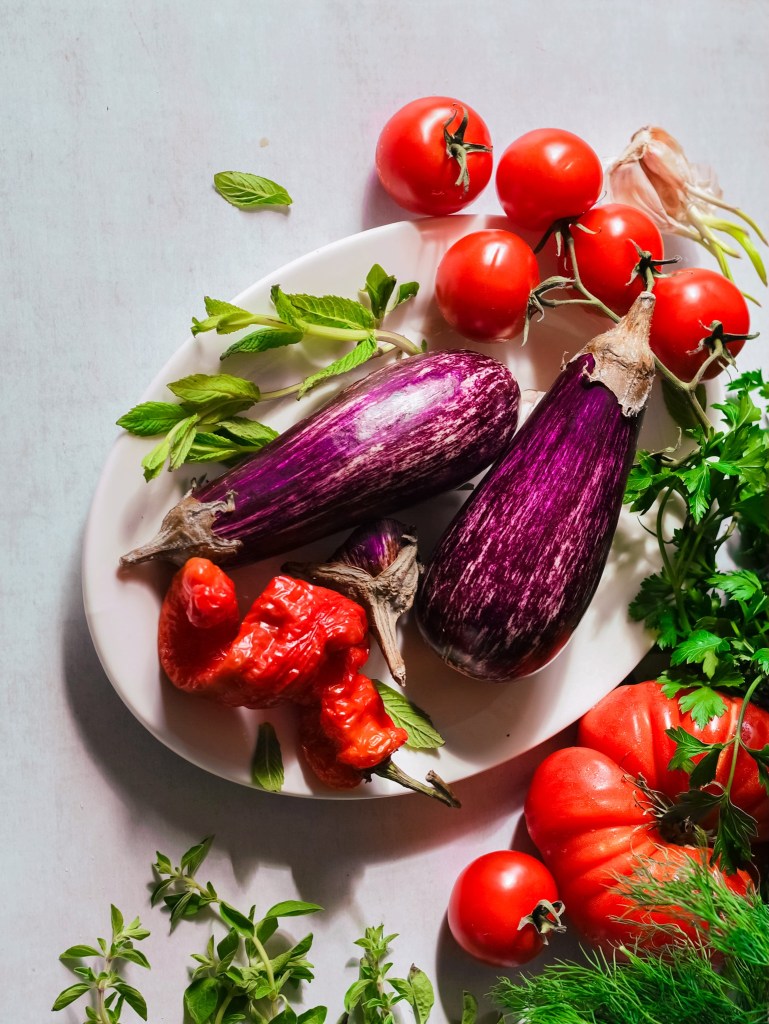
How to buy, pair and cook eggplants.
One of the most polarizing produce items; you either love them or hate them. we love them here at The Wonky Stove. My goal is create an eggplant recipe for each month of the year. If you already love eggplant parmesan and baba ganoush this is the post and blog for you.
Technically they are a fruit, like a tomato and part of the nightshade family of plants, much like a tomato, potato or pepper. Additionally they pair well with tomatoes, potatoes and peppers and a very long list of other herbs, vegetables and cheeses.
The only limitation of eggplants is that they need to be cooked well done and beyond. Think high heat. The complete opposite of how we’ve been told to consume our vegetables. Eggplants also need a good amount of fat, that is oil or accompanying cheese. They are little delicious sponges that will soak up oil quicker than you have a chance to add it! I have a few sneaky tricks that will help minimize the oil without compromising the flavor.
Reasons to love an eggplant:
Available year round
Affordable
Satisfying and nutritionally dense
Can be prepared in advance
Delicious cold or hot
Buying Eggplant
In recent years there has been an explosion of eggplant varieties in grocery stores, and this is true for other produce too. The most common eggplants available are globe eggplant, Japanese eggplant and Indian eggplant. Of the most recent varieties spotted are fairy tale, graffiti, white and Sicilian.
The earliest cultivated eggplant looked like an egg, a little white or yellowish globe hanging off the eggplant branch. If you ever find a white eggplant, you’ll understand why! Alternately they are called aubergine in most of Europe, and “blues” siniye in my home city of Odesa, Ukraine, where I consider them to be the unofficial veggie mascot.
Buying eggplants at the grocery store:
Male vs Female
The male fruit will have fewer seeds and ideally be less bitter. Female eggplants are just as delcious but their extra seeds can cause an unpleasant tannic mouthfeel, which can be adjusted for with some cooking methods. Here is a google link for you to study the differences.
Globe, white or Italian eggplant:
Bigger is not better. You want a nice firm eggplant that is no wider than 4 fingers and two palms in length. The skin should be shiny and tight and a flick along its side should result in a shallow thud. The skin of the globe or Italian eggplant can be bitter and tough. Typically it is either fully or partially removed. The meat of these eggplants is substantial and well, meaty. The bonus to their tough skins is that they hold up to being grilled whole, sliced and rolled with a filling or scooped out and blended into a sauce. Of all the eggplants this is the most versatile and widely available, but why limit yourself?
A method my uncle used at every shashlik aka Ukrainian or Central Asian bbq was to throw an entire well cleaned eggplant into the flames of a mangal (a wood and charcoal grill commonly used to grill across the SWANA and neighboring regions as well as in Ukraine and Central Asia). It would be cooked until the skin charred black with a few radiating embers. The entire eggplant would then be submerged into a bowl of very salty water, peeled, chopped and combined with chopped grilled tomato and rings of raw marinated onion. This is still my favorite side to any shashlik.
Japanese eggplant ( Some stores will label as Chinese or Asian eggplant)
They have a beautiful vibrant purple skin, which when cooked will only intensify in color. The same principles apply when buying this variety. The only distinction is that these eggplant have a leaner and longer build. You’ll want a nice firm fruit with bright tight skin, avoid buying eggplant that is too thick or short. Two palms is the standard length. Their texture and flavor work well in dishes calling for whole pieces. since the skin is tender enough to enjoy after cooking, slices retain their shape after a saute, fry or bake.
Graffiti Eggplant:
They are a bright purple and striped with white. Typically their size is about a palm and a half and the same selection as globe, Italian or white apply. Too thick and they may be spongy and possibly bitter. The skin can remain in the eggplant and they are wonderful for using to stuff, cut into rounds and bake as a topping for salad, pizza or rice.
Fairy tale/Sicilian:
Think fairy tale pumpkin but eggplant. They are pudgy and round with lovely gourd like creases. In color they are sort of an ombre of white and vivid aubergine. They should be firm with a little give, too firm and their flavor is too bitter, too soft and the taste and texture are off. I would describe it as just under ripe tomato in hardness. Their flavor and texture is very delicate, making them better suited for sauces and spreads.
Indian eggplant:
They are sometimes speckled or a solid eggplant color. Identified by being round and looking like cheerful eggplant ornaments. They should be heavy for their size, with a vibrant skin and vivid green stem, firm but not hard as a rock. They are lovely stuffed, cooked and marinated whole or scooped out for a dip or sauce. Their skins are very tender and they have minimal seeds, making them fantastic for well, everything.
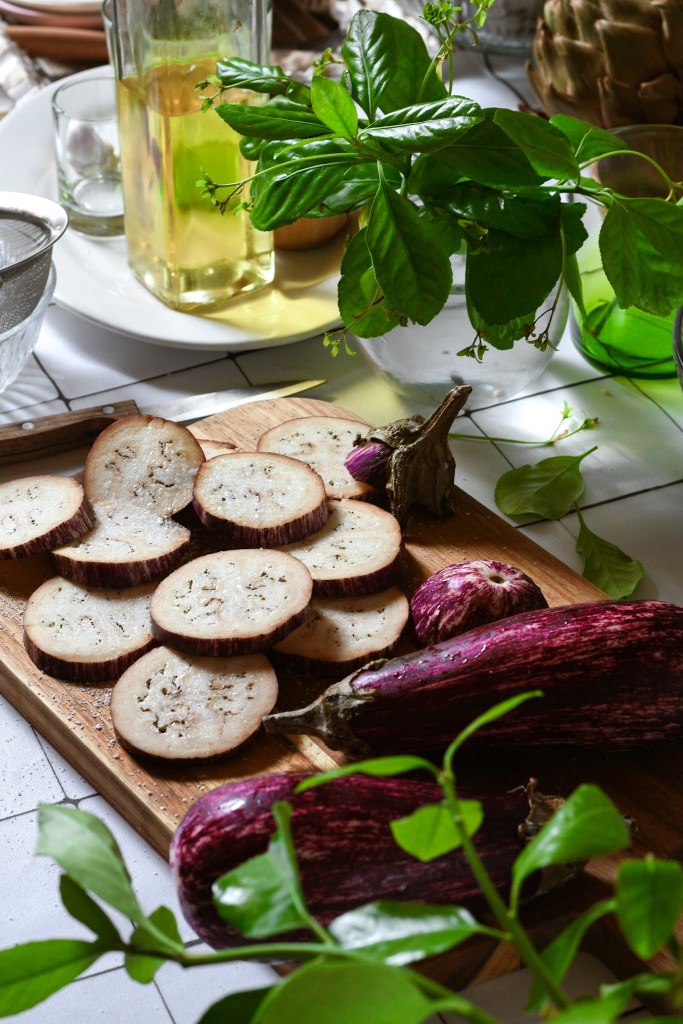
Flavor Pairings with Eggplant
A quick and easy list to reference
Aromatics
Garlic
Onion
Fennel
Carrot
Celery
Ginger
Bay Leaf
Chili
Leek
Scallion
Herbs
Parsley
Dill
Cilantro
Thyme
Basil
Fenugreek
Mint
Chives
Dry adjika seasoning
Green or red adjika paste
Fresh Adjika
Vegetables etc
Tomato
Sweet Pepper
Potato
Arugula
Spinach
Horseradish
Walnuts
Pinenuts
Cheese
Feta
Sulguni
Briny Brindza
Mozzarella
Goat’s or Sheep’s milk cheese
Farmer’s Cheese
Ricotta
Provolone
Parmesan
Cooking The Eggplant
Microwave
The microwave is one of my favorite eggplant prep hacks. This is applicable for the globe, italian, white and graffiti varieties. They can be tougher and sometimes bitter but a a few minutes in the microwave before cooking will get the bitterness out, some moisture and have it ready for frying or saute.
Chop your eggplant according to the recipe, salt lightly and pop into a microwave for 2 minutes per 2 cups of eggplant. Strain from the liquid and continue cooking as needed. They will require much less oil, cook faster and retain less bitterness.
Note: This is not applicable for eggplants that are cut lengthwise for rolling with a stuffing. These can be cut, salted and left to sweat on the counter between 15 to 3 minutes. Small droplets of water will collect on the surface and a bit of brown liquid will pool underneath. These are then rinsed, squeezed gently and patted dry before cooking. The eggplant will become more flexible and pliable after salting.
Salting can be used on any of the above mentioned eggplants! See which method works best for you and your dish.
Grilling
I mentioned further up that my favorite is the shashlik technique taking an whole eggplant and absolutely destroying it in a hot grill, submerging it into a bowl of salty cold water and then peeling it to use in a dip or spread.
More technically you want to take your eggplant and cook the entire surface until the skin is charred black and the fruit looks wrinkled and collapsed. This can be done in a hot oven or airfryer as well, my grandma would often use a dry hot skillet on the stove top but that would smoke up the house something awful.
If you can’t get to a grill to try the shashlik technique, here is the way to do it in an oven or airfryer.
Oven:
Halve, salt and oil the eggplant
Place cut side DOWN into a 425F oven for 30minutes. Remove and scoop out meat
Airfryer:
Halve, salt and oil the eggplant.
Place cut side UP starting at 300F for 6 minutes and ending for 15 additional minutes more at 400F. Remove and scoop out meat.
I think I covered the majority of ways to select, cook and season an eggplant. Stay tuned for recipes to use up your new favorite vegetable.
 The Wonky Stove